
Http Service
We use a microservice architecture. Our app serves requests from others and also calls other services.
With that in mind, zero gives you a built-in way to register and talk to external services, much like making a database call.
What is supported?
- Inter service http calls (GET, POST, PATCH, PUT, DELETE)
- Log and trace all outgoing calls
- Health checks
- Outbound authentication (Basic / API Key / OAuth bearer) attached per service
- Circuit breaker (fail-fast when a downstream is unhealthy)
- Per-service rate limiting for outbound calls
Usage
zero ships an addHttpService method. It registers an HTTP client that you can reach through the context.
Use a unique service name so clients stay distinct for the life of the zero app.
app.addHttpService("service-name", "http://service-base-url");

// if you prefer to load the URL from configs
app.addHttpService("service-name", app.config.Get("SERVICE_URL"));
Example
- See the
zero-service-clientexample to get started.
const std = @import("std");
const zero = @import("zero");

const App = zero.App;
const Context = zero.Context;
const utils = zero.utils;
const ClientError = zero.Error.ClientError;

pub const std_options: std.Options = .{
    .logFn = zero.logger.custom,
};

pub const publicKey = struct {
    kid: []const u8,
    kty: []const u8,
    use: []const u8,
    n: []const u8,
    e: []const u8,
    alg: []const u8,
};

pub const publicKeys = struct {
    keys: []publicKey,
};

pub fn main(init: std.process.Init) !void {
    var arean = std.heap.ArenaAllocator.init(std.heap.page_allocator);
    defer arean.deinit();

    const allocator = arean.allocator();

    const app = try App.new(allocator, init.io, init.environ_map);

    try app.addHttpService("auth-service", app.config.Get("SERVICE_URL"));

    try app.get("/status", serviceStatus);

    try app.run();
}

fn serviceStatus(ctx: *Context) !void {
    const service = ctx.getService("auth-service");

    if (service) |authSvc| {
        const response = try authSvc.Get(ctx, publicKeys, "/keys", null, null);
        try ctx.json(response);
    }
}APP_ENV=dev
APP_NAME=service-client
APP_VERSION=1.0.0
LOG_LEVEL=info
HTTP_PORT=9090
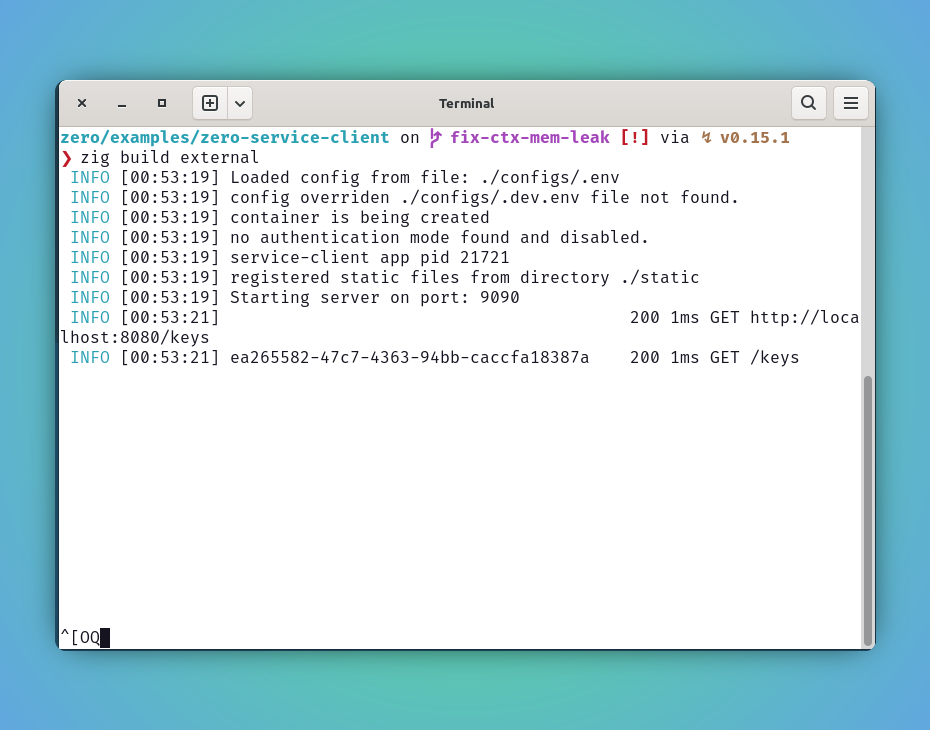
SERVICE_URL="http://localhost:8080"- Build and run the app.
❯ zig build external
 INFO [00:53:19] Loaded config from file: ./configs/.env
 INFO [00:53:19] config overriden ./configs/.dev.env file not found.
 INFO [00:53:19] container is being created
 INFO [00:53:19] no authentication mode found and disabled.
 INFO [00:53:19] service-client app pid 21721
 INFO [00:53:19] registered static files from directory ./static
 INFO [00:53:19] Starting server on port: 9090
 INFO [00:53:21]                                     	 200 1ms GET http://localhost:8080/keys
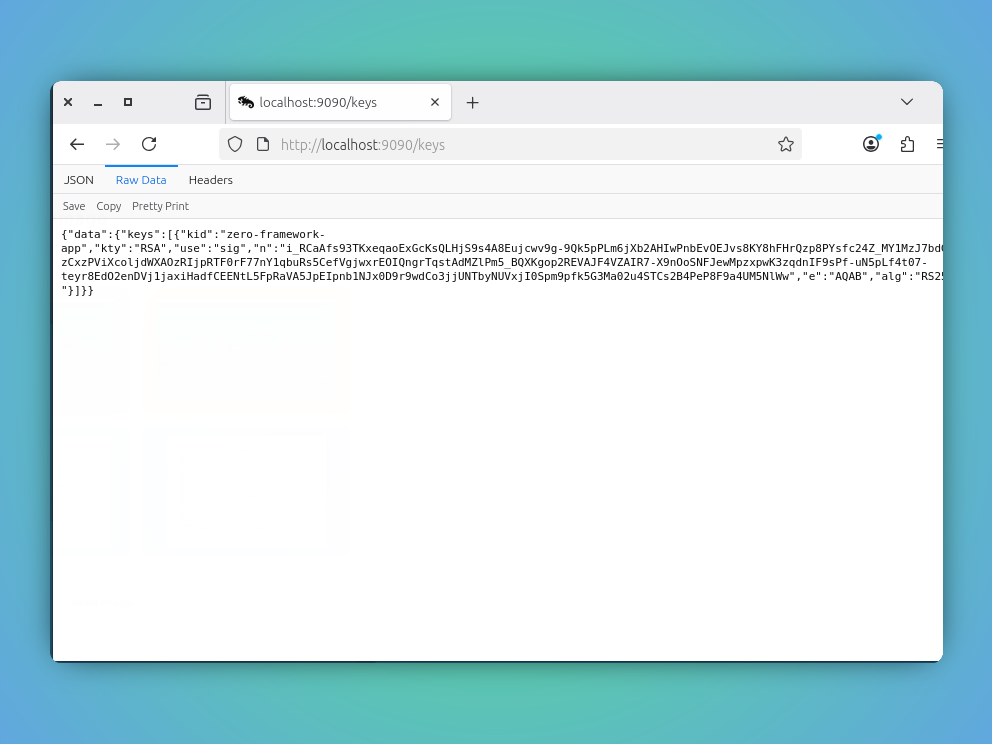
INFO [00:53:21] ea265582-47c7-4363-94bb-caccfa18387a 200 1ms GET /keys- Preview the server status and capture the
auth-servicepublic keys.
Assume you already run the zero-basic app on HTTP port 8080 to serve the request.
Outbound Authentication
Attach credentials to every request a service sends by passing opts.auth to addHttpService. Three modes are supported: basic, apiKey, and oauth. For OAuth, zero fetches and caches the bearer token and refreshes it before it expires, so you don't manage tokens yourself.
const zeroClient = zero.service.client;

// Basic
try app.addHttpService("legacy", "http://legacy.internal", .{
    .auth = .{
        .mode = .basic,
        .basic = .{
            .username = "svc",
            .password = "secret"
        }
    },
});

// API Key (sent as the `x-api-key` header)
try app.addHttpService("partner", "http://partner.internal", .{
        .auth = .{
            .mode = .apiKey,
            .apiKey = .{
                .key = "caf208fb-..."
            }
        },
});

// OAuth (token auto-fetched and refreshed)
try app.addHttpService("auth-service", "http://localhost:8080", .{
    .auth = .{ .mode = .oauth, .oauth = .{
        .tokenUrl = "http://localhost:8080/oauth/token",
        .clientId = "svc",
        .clientSecret = "secret",
        .scope = "read",
        .audience = "zero-app",
    } },
});
Circuit Breaker
A circuit breaker fails fast when a downstream service is unhealthy, instead of piling up timed-out calls. It opens after failure_threshold consecutive failures. It stays open for cooldown_ms, then allows half_open_trials probe requests before closing again. While open, calls return error.CircuitOpen.
try app.addHttpService("flaky", "http://flaky.internal", .{
    .circuitBreaker = .{
        .failure_threshold = 5,
        .cooldown_ms = 30_000,
        .half_open_trials = 1
    },
});
Defaults: failure_threshold = 5, cooldown_ms = 30000, half_open_trials = 1.
Rate Limiting (per service)
Each registered service can use a fixed-window limiter for its outbound calls. When limit requests happen within window_ms, further calls return error.RateLimited (surfaced as ClientError.RateLimited) without reaching the network.
try app.addHttpService("downstream", "http://downstream.internal", .{
    .rateLimiter = .{
        .allocator = allocator,
        .enabled = true,
        .limit = 100,
        .window_ms = 60_000
    },
});
Resilience: timeouts & retries
Outbound calls can be hardened with a per-request timeout and automatic retries. Pass opts.timeout_ms, opts.max_retries, and opts.retry_base_ms:
try app.addHttpService("downstream", "http://downstream.internal", .{
    .timeout_ms = 2000,     // connect/read timeout per request
    .max_retries = 3,       // retries on transport errors and 5xx
    .retry_base_ms = 100,   // linear backoff: delay = base * attempt
});- Retries apply to transport errors and
5xxresponses;404is not retried (it returnserror.EntityNotFound). - Backoff is linear: the delay before attempt
nisretry_base_ms * n. - For OAuth services, a
401triggers a single token-refresh and replay before the call is treated as failed.
OAuth token-endpoint circuit breaker
The OAuth token endpoint has its own circuit breaker. If it is open or a refresh fails, zero falls back to the last cached token, even if it's stale, rather than failing every call. This keeps downstream calls working in a degraded state while the token provider is unhealthy.
When a service breaker or the token breaker trips, zero increments the app_circuit_open_total metric (label = service name).
Configuration via environment
Instead of writing code, resolve a service's auth, circuit-breaker, and rate-limit settings from SERVICE_<NAME>_* env keys. The service name is uppercased and its non-alphanumeric characters become _.
For addHttpService("auth-service", ...) the prefix is SERVICE_AUTH_SERVICE_.
# outbound auth
SERVICE_AUTH_SERVICE_AUTH_MODE=oauth
SERVICE_AUTH_SERVICE_OAUTH_TOKEN_URL=http://localhost:8080/oauth/token
SERVICE_AUTH_SERVICE_OAUTH_CLIENT_ID=svc
SERVICE_AUTH_SERVICE_OAUTH_CLIENT_SECRET=secret
SERVICE_AUTH_SERVICE_OAUTH_SCOPE=read
SERVICE_AUTH_SERVICE_OAUTH_AUDIENCE=zero-app
# basic: SERVICE_AUTH_SERVICE_BASIC_USER / SERVICE_AUTH_SERVICE_BASIC_PASS
# apiKey: SERVICE_AUTH_SERVICE_API_KEY

# circuit breaker
SERVICE_AUTH_SERVICE_CB_FAILURE_THRESHOLD=5
SERVICE_AUTH_SERVICE_CB_COOLDOWN_MS=30000
SERVICE_AUTH_SERVICE_CB_HALF_OPEN_TRIALS=1

# outbound timeouts & retries
SERVICE_AUTH_SERVICE_TIMEOUT_MS=        # per-request connect/read timeout (ms); unset = framework default
SERVICE_AUTH_SERVICE_MAX_RETRIES=3      # retries on transport errors + 5xx (not 404)
SERVICE_AUTH_SERVICE_RETRY_BASE_MS=100  # linear backoff: delay = base * attempt

# rate limiting
SERVICE_AUTH_SERVICE_RATE_LIMIT=100
SERVICE_AUTH_SERVICE_RATE_LIMIT_WINDOW_MS=60000// env-driven: addHttpService resolves SERVICE_AUTH_SERVICE_* automatically.
// Explicit opts override the env defaults, so passing .{} keeps the env values.
try app.addHttpService("auth-service", "http://localhost:8080", .{});Limitations
We see memory leaks when we access an external service URL over https with compression enabled. Work is in progress to fix this.